Skip to content

Health information

Hernia: When Should You Worry?

Abdominal & gallbladder · 1 min

Recognise a hernia lump and the warning signs of complications.

The warning signs to take seriously

A lump in the groin or abdomen that appears when you stand, cough or strain may be a hernia. Most hernias are not an emergency, but a hernia can become one.
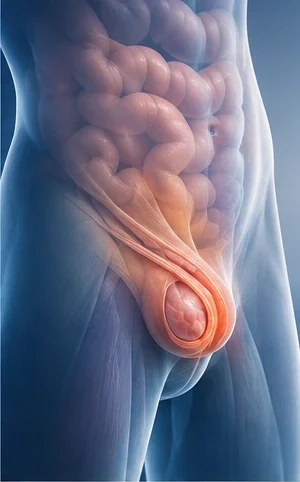
Illustration of an inguinal hernia, with part of the bowel passing through the abdominal wall into the groin.

Seek urgent assessment if

  • The lump becomes very painful and cannot be pushed back in
  • Vomiting or abdominal bloating develops
  • The skin over the hernia changes colour

Assessment is usually by clinical examination, with an ultrasound or CT scan in selected cases, and a pre-operative health assessment if surgery is required.

If your symptoms persist or you are unsure of the cause, arrange an assessment.

A hernia occurs when tissue or part of the bowel pushes through a weak area in the abdominal wall. Hernias may occur in the groin, at the navel or through a previous surgical scar.

When should you be assessed?

  • A lump in the groin, navel or abdominal wall
  • A feeling of heaviness or discomfort
  • Pain when coughing, straining or lifting
  • Swelling that becomes more noticeable when standing

Treatment Options

Hernias are treated surgically. If a hernia is symptomatic or at risk of complications, earlier repair may be recommended. Surgery may be performed laparoscopically or through an open approach depending on the type and size of the hernia, previous surgery and the patient’s condition.

Read More: Hernia

Health information

Patient Education

Read health information
  • Blood in the Stool: Haemorrhoids or Cancer?

    Why blood colour alone is not enough to determine the cause.

    Colorectal & perianal

    Read More
  • Colorectal Cancer Can Be Asymptomatic

    The importance of screening and understanding risk factors.

    Colorectal & perianal

    Read More
  • Do Haemorrhoids Need Surgery?

    When conservative treatment may be enough and when a procedure is considered.

    Colorectal & perianal

    Read More
  • Haemorrhoid Grades

    A simple explanation of Grades I to IV.

    Colorectal & perianal

    Read More

Book an Appointment

If your symptoms persist or you are unsure of the cause, arrange an assessment.